
Twenty-four million young players, a federation reborn on paper, and a ranking that has barely moved in three decades. The story of football in Pakistan is not a story of talent. It is a story of governance
On a warm evening at Jinnah Sports Stadium in Islamabad, thousands of fans once packed the stands to watch Pakistan take on visiting opposition in a World Cup qualifier, a scene that surprises outsiders who assume the country only fills stadiums for cricket. The green shirts on the pitch that night carried the weight of a following that has never needed convincing. Football is, by most informal counts, the second most followed sport in Pakistan, played on streets, rooftops, and dusty school grounds from Karachi to Chitral by a population in which roughly two out of every three citizens are under the age of thirty. And yet, at the start of June 2026, the senior men’s national team sat 202nd out of 211 nations in the FIFA World Ranking, among the lowest positions held by any South Asian side and closer to the very bottom of the list than to the middle of it. The paradox of Pakistani football, a game adored by millions and mastered by almost none of its institutions, is the subject of this article. The gap between affection and achieve-ment is not new, and it is not, on close inspection, a gap of ability. It is a gap of structure. For a decade, Pakistan’s football federation was run not by an elected board but by a succession of FIFA-appointed committees, its offices raided at least once by rival claimants to power, its international standing suspended three separate times since 2017. Its domestic league, once a going concern with promotion and relegation, has not completed a full home-and-away season since 2018 to 2019. Its brightest recent achievement, a first-ever advance to the second round of World Cup qualifying in 2023, was managed by a team that, in the years before and after, had almost no regular competition to sharpen it.
A COUNTRY THAT LOVES THE GAME IT CANNOT YET WIN
Pakistan’s relationship with football predates its relationship with the FIFA World Ranking by decades. The Pakistan Football Federation has held FIFA membership since 1948 and Asian Football Confederation membership since 1954, and the national team’s best-ever position, 141st in the world, dates back to February 1994. Since then, the trend line has run mostly downward, bottoming out at 205th in June 2019, a season in which the federation was already deep into the governance crisis that would come to define the following ten years.
None of this reflects a shortage of interest. Football is widely described by sports administrators and researchers as the country’s second-favourite sport after cricket, and it commands an outsized following among the young in cities such as Karachi, Lahore, and Quetta, where street and futsal-style games fill the gaps left by a scarcity of grass pitches.
PAKISTAN FOOTBALL, BY THE NUMBERS
| FIFA men’s world ranking, start of June 2026 (of 211 nations) | 202nd |
| Highest ranking ever held | 141st (Feb. 1994) |
| Lowest ranking ever held | 205th (June 2019) |
| FIFA suspensions of the federation since 2017 | Three |
| Years since the federation last held a president-level election before May 2025 | About ten |
| Years since a home-and-away national club league was completed | About seven |
| Population under age thirty, of roughly 241 million citizens | About two-thirds |
TEN YEARS UNDER OUTSIDE MANAGEMENT
To understand why a country of this size and enthusiasm has struggled to build a competitive national side, it helps to trace the federation’s recent institutional history, because the story of Pakistani football since the mid-2010s is, in large part, a story about who controls its federation rather than who plays for its team.
The trouble began in 2015, when rival factions contested control of the Pakistan Football Federation, a dispute that dragged on for years and drew in the courts, the government, and eventually FIFA itself. FIFA first suspended the federation in October 2017 over undue third-party interference, lifting the ban in March 2018. A Supreme Court-ordered election that same year installed a leadership FIFA refused to recognise, and when that group forcibly occupied the federation’s Lahore headquar-ters in March 2021, FIFA suspended Pakistan again within days, cutting the country off from international competition for fifteen months. A FIFA-appointed Normalisation Committee, first under Haroon Malik and later under successive chairs, took charge from 2019 onward with a mandate to hold fresh, FIFA-compliant elections. That mandate slipped for years. A third suspension followed in February 2025, this time over the federation’s failure to adopt a revised, FIFA-and-AFC-approved constitution, though it lasted less than a month before the constitution was ratified and the ban lifted on 2 March 2025.
A First Election in a Decade
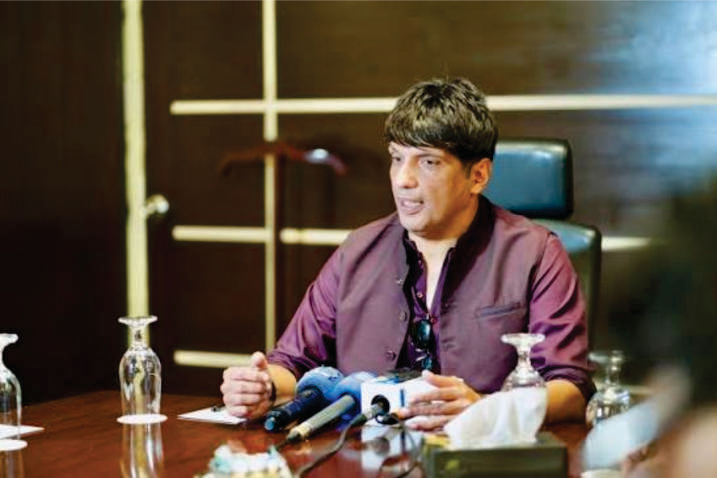
The constitutional fix cleared the way for the federation’s first presidential election in roughly ten years. On 27 May 2025, Syed Mohsen Gilani, a former FIFA development officer, defeated Karachi United founder Taha Alizai by a vote of 13 to 11 among the federation’s Congress, ending the Normalisation Committee era and installing an elected board for the first time since the crisis began. Gilani inherited a federation whose institutional memory had been shaped almost entirely by administrators appointed from Zurich rather than by consensus at home.
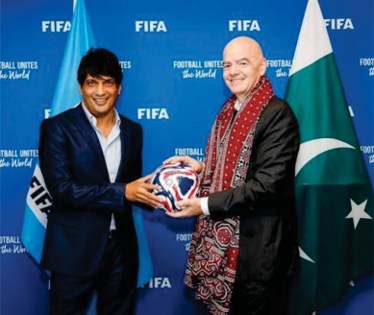
Governance has been the core of our issues, and I will look to strengthen that . (SYED MOHSEN GILANI, PFF PRESIDENT, ON TAKING OFFICE IN MAY 2025)
Observers of the federation have long argued that the fight for its leadership has had less to do with football philosophy than with the money that comes attached to the presidency. Reporting on the federation's long crisis has noted that control of the PFF carries with it guaranteed annual funding running into the millions of dollars from FIFA and the AFC, an incentive that, critics say, has periodically mattered more to contesting factions than the state of the national team itself.
A LEAGUE PAKISTAN DOES NOT HAVE
If governance explains why Pakistan’s football administration has struggled, the absence of a functioning domestic league explains why its players have struggled to improve once selected. The Pakistan Premier League, the top tier of the domestic pyramid since 2004, ran with reasonable regularity until a crisis suspended competitions in 2015. It returned for one season in 2018 to 2019, the last time a full home-and-away campaign was completed, before an attempted comeback in 2021 to 2022 was abandoned and later declared null and void. At the start of June 2026, Pakistan had gone without a completed, home-and-away professional league season for roughly seven years, a gap with few parallels among FIFA’s 211 member associations.
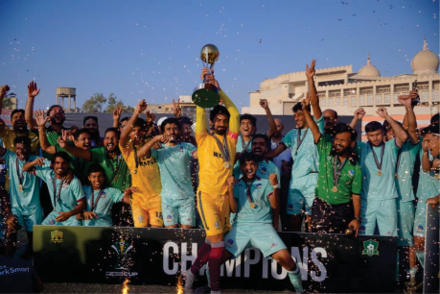
In its place, the federation has leaned on the National Challenge Cup, a knockout tournament contested by departmental sides, the works teams fielded by government bodies, utilities, and the armed forces, a model dating to an era when football, like several other Pakistani sports, was sustained largely through public-sector employment rather than private clubs. The most recent edition, the tournament’s thirty-first, was played across two Karachi venues in February 2026 and won by WAPDA, the utility company side, over Khan Research Laboratories in the final. The departmental system has kept a form of national competition alive through the league’s long absence, but it offers a fundamentally different pathway from the club academies and promotion-and-relegation structures that develop players in the football nations Pakistan hopes to compete against.
WHERE THE MONEY GOES, AND DOES NOT GO
Money, or its absence, runs through nearly every strand of this story. Pakistan’s sporting economy is overwhelmingly organised around cricket. The Pakistan Cricket Board approved an operational budget of roughly PKR 15 billion for the 2022 to 2023 financial year, with about seventy-eight per cent of that sum earmarked for cricket-related activity. By contrast, the Pakistan Sports Board, the government body that distributes public grants across the country’s other federations, disbursed a combined total of just under PKR 102 million to all twenty-three non-cricket sporting federations for the 2024 to 2025 financial year, a sum smaller than a rounding error in the cricket board’s accounts and one that had to stretch across hockey, squash, athletics, and football alike.
Football’s own finances have followed a troubling pattern of their own. Independent reporting has estimated that the federation has historically
received close to 1.25 million dollars a year from FIFA’s development programme, with a further sum of up to 800,000 dollars available from the AFC, funding intended to build academies, train AFC, funding intended to build academies, train coaches, and support competitions. Little of that investment has produced lasting, visible infrastructure. In September 2025, nine members of the federation’s own Executive Committee formally asked FIFA to audit close to two billion rupees, roughly seven million dollars, reportedly spent by the Normalisation Committee between 2020 and 2025, after players and officials continued to report unpaid salaries and threadbare facilities despite the scale of the outlay. The identity of intermediaries said to have handled part of that spending remained, as of this writing, publicly unresolved.
Control for the PFF is motivated by a desire to control the large sums of money associated with it. (ALI AHSAN, EDITOR, FOOTBALLPAKISTAN.COM)
SMALL STEPS BACK TOWARD THE WORLD
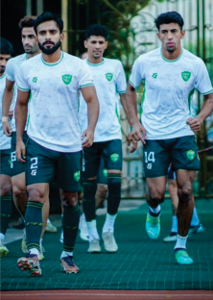
None of this is to say that Pakistani football stood still. The year leading up to June 2026 produced more credible momentum than the sport had seen in a decade, even if that momentum remained fragile and unproven at scale.
The clearest marker came on the pitch. Under American-based English coach Stephen Constantine, who managed the side from September 2023 to October 2024, Pakistan advanced to the second round of Asian qualifying for the 2026 FIFA World Cup for the first time in its history, a milestone built on the team’s first-ever World Cup qualifying victory. Constantine’s successor, former Newcastle United and Peru international Nolberto Solano, took charge of the senior and under-23 sides in July 2025 on a one-year agreement, tasked with converting that historic breakthrough into sustained results rather than a single high point. By early June 2026, reports out of Pakistan suggested the team had strung together back-to-back wins against higher-ranked opposition, results that, if confirmed in the following ranking cycle, stood to lift the side out of the 200s for the first time in several years.
Off the pitch, President Gilani’s administration devoted considerable energy to rebuilding relationships that a decade of suspension had frayed. At the FIFA Congress in Vancouver in May 2026, PFF officials met with the presidents of the Saudi Arabian and Thai football federations, discussed coach-education cooperation with Guyana’s federation, and secured what the AFC’s leadership publicly described as satisfaction with the progress made on infrastructure and grassroots activity. A memorandum of understanding signed with Azerbaijan’s federation in 2025 targeted youth development and coaching exchange, part of a broader pattern of bilateral outreach in place of the isolation that had defined the suspension years, and one that stood in visible contrast to a system long criticised for having no coach-education pipeline to speak of.
Progress Beyond the Men’s Team
Some of the most tangible gains arrived away from the senior men’s side. Pakistan fielded a national futsal team for the first time only in October 2025 and a women’s futsal team that, by May 2026, had climbed to 94th in the FIFA Futsal Women’s World Ranking after competing at the inaugural SAFF Women’s Futsal Championship in Thailand.
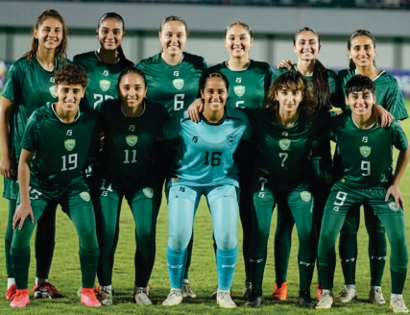
The women’s eleven-a-side team, ranked 154th in June 2026, recorded its largest-ever victory in April 2026, an eight-goal romp over Turks and Caicos during an international window in Côte d’Ivoire. None of these results place Pakistan near the top of Asian football, but each represents a program that, as recently as 2022, barely existed in international competition at all.
THE DISTANCE BETWEEN A FOLLOWING AND A TEAM

Set against one another, these two currents, a federation still working through the debris of a lost decade and a young team beginning to post its best results in a generation, describe a sport in transition rather than a sport in crisis or a sport transformed. The passion was never the missing ingredient. A country in which roughly two-thirds of the population is under thirty, and in which football ranks second only to cricket in everyday following, was never going to lack for players or spectators. What it lacked, for the better part of ten years, was an institution capable of turning that following into a functioning pipeline: a league that runs its full season, a federation that survives an election cycle without a suspension, a set of accounts that can withstand an audit without controversy.
The twelve months upto June 2026 offered the first sustained stretch in a decade in which those institutional foundations, rather than administrative inghting, occupied the centre of the football conversation in Pakistan. A stadium-building partnership, a coach with a mandate to build on genuine sporting history rather than manage decline, a federation talking to its regional neighbours instead of fighting itself in court, none of these guarantees a rise up the FIFA table on their own. Taken together, though, they mark the difference between a sport waiting to be noticed and a sport beginning, cautiously, to build the case for being taken seriously. Whether that case survives the next election cycle, the next audit, and the next FIFA deadline is the question that will determine whether Pakistan’s football story, three decades after its best-ever ranking, finally starts moving in the other direction.
Leave a Reply