
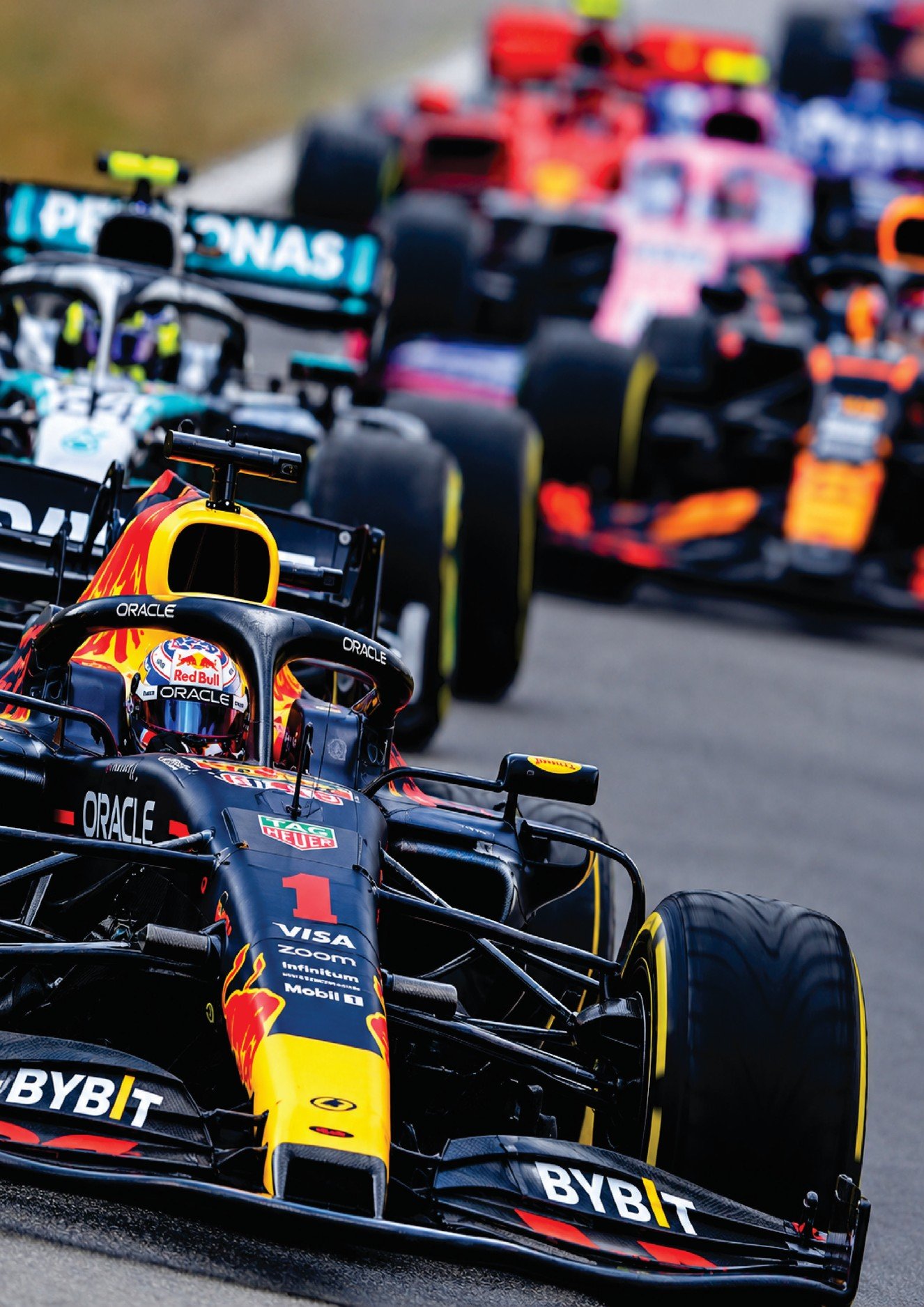
Behind the glamour and the celebrity lies a sport of brutal physical demands, relentless engineering, and quiet sacrifice. We look past the glamour to find what truly drives Formula One (F1).
Under the floodlights of Singapore’s Marina Bay, 22 cars scream past the city skyline at more than 300 kilometres per hour. From the harbour of Monaco to the packed grandstands of Silverstone, Formula One (F1) carries an aura of prestige that few sports can match. Its drivers are global celebrities, its paddock is a meeting place for film stars and business leaders, and its winners celebrate from podiums watched by hundreds of millions of people around the world.
To an outsider, the sport can look simple: a group of wealthy young men driving fast cars around oddly shaped circuits every other weekend. That view misses almost everything. Beneath the bright helmets and sponsor logos lies a world built on relentless precision, technical mastery, and logistics on a scale few industries attempt. Entire teams of engineers, strategists, mechanics, and analysts work behind the scenes, moving tonnes of equipment across continents in pursuit of fractions of a second. A single tenth can separate pole position from the middle of the grid, and a single point can decide a world championship.
Formula One is not merely a race. It is a meeting of human ambition, engineering brilliance, and a generous measure of risk. To understand it, one has to look past the podium to the people, the bodies, and the machines that make it possible.
The Long Road from the Kart Track
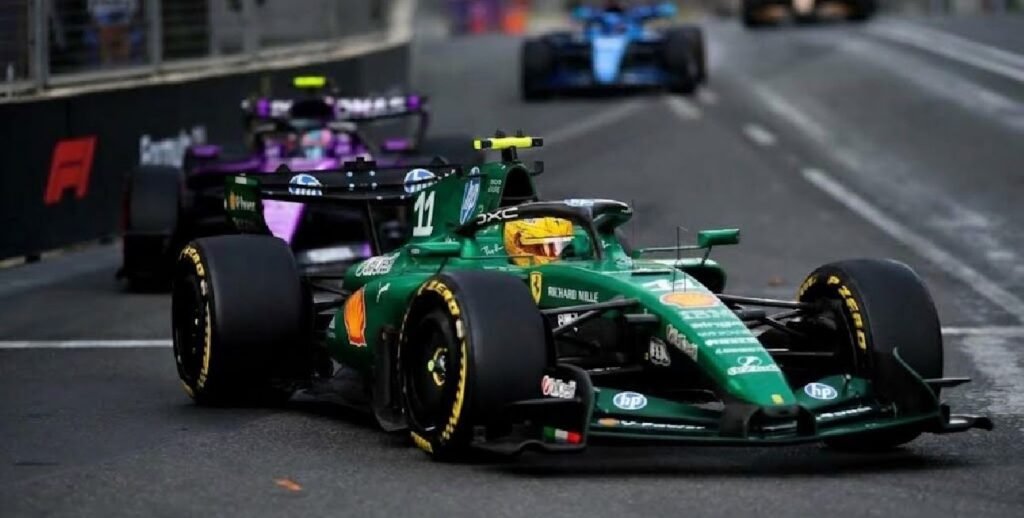
No driver arrives at the pinnacle of motorsport overnight. Every athlete on the grid began the journey long before fame and fortune entered the picture, usually by climbing into a kart at an age when most children are still learning to ride a bicycle. Max Verstappen, who has won four world championships, was racing karts at the age of four. Most of his rivals began before their tenth birthday.
Karting is the foundation of the sport. On small, tight circuits, children learn the core of race craft: how to find the fastest line through a corner, how to brake at the last possible moment, how to pass cleanly, and how to defend without causing a collision. The lessons learned at eight years old still shape how a driver attacks a corner at thirty.
A Ladder Built on Money and Nerve
From karting, the path climbs through a series of junior categories, typically Formula 4, the regional championships, Formula 3, and Formula 2. Each step brings faster cars, larger budgets, and fewer seats. To race in Formula One at all, a driver must hold a super licence from the FIA, the sport’s governing body, which in most cases requires 40 points gathered from results in approved championships over three seasons. Talent alone does not guarantee a place. Timing, results, and financial backing must all fall into line.
The financial demands are severe. Families pay for travel, equipment, engines, tyres, and mechanics, and the costs rise sharply with each category. Estimates for the full journey from karting to the threshold of Formula One commonly run into millions, and a single season in Formula 2 can cost well over a million euros on its own. By their mid teens, many gifted drivers are forced to stop, not because they lack speed but because their families can no longer pay. Junior programmes run by teams such as Ferrari, Mercedes, Red Bull, and McLaren offer a lifeline to a fortunate few, but places are scarce and the pressure to perform is immense.
Yet despite these barriers, there are rare stories of perseverance that inspire not only racing fans but anyone with a large dream and limited means. No story captures this more powerfully than that of Lewis Hamilton.
Lewis Hamilton: The Outsider Who Rewrote the Record Books
Hamilton was born in 1985 in Stevenage, a town north of London, and grew up in modest circumstances. His father, Anthony, worked several jobs at once to keep his son racing, and the family often arrived at karting events with secondhand equipment to face rivals whose budgets dwarfed their own. Hamilton began racing karts at the age of eight and soon showed rare speed.
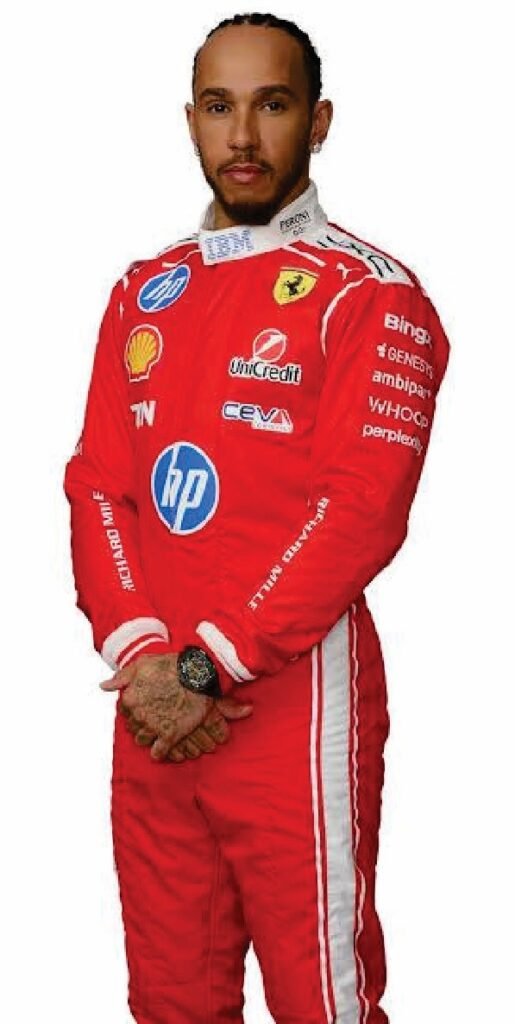
Hamilton was born in 1985 in Stevenage, a town north of London, and grew up in modest circumstances. His father, Anthony, worked several jobs at once to keep his son racing, and the family often arrived at karting events with secondhand equipment to face rivals whose budgets dwarfed their own. Hamilton began racing karts at the age of eight and soon showed rare speed.
In 1995, aged ten, he met Ron Dennis, the head of McLaren, at an awards ceremony and told him that he would one day race for his team. Dennis wrote in the boy’s autograph book that he should call him in nine years. Hamilton did not have to wait that long. In 1998, McLaren signed him to its young driver programme, and in 2007 he made his Formula One debut for the team, finishing on the podium in his very first race.
What followed is one of the great careers in sporting history. Hamilton lost the 2007 title by a single point as a rookie, then won it the following year in dramatic fashion, snatching the championship in the closing corners of the final lap in Brazil. After moving to Mercedes in 2013, he won six more titles between 2014 and 2020, equalling Michael Schumacher’s record of seven world championships. Along the way he set new records for the most race wins and the most pole positions in the history of the sport.
“Hamilton proved that a driver from an ordinary background could reach the very top of a sport built on privilege.”
His achievements carry extra weight because of the barriers he faced. Hamilton became the first Black driver to race in Formula One, entering a sport long associated with wealth and exclusivity. He has spoken openly about the racist abuse he endured as a child and as a professional, and about how few people in the paddock shared his background. Rather than stay silent, he used his platform.
In 2025 he began a new chapter with Ferrari, fulfilling a childhood dream of driving in red. Whatever the results of this late stage of his career, his place in the story of the sport is secure. Hamilton proved that a driver from an ordinary background could reach the very top, and he changed what young fans around the world believe is possible for someone like them.
Built for Punishment: The Athlete in the Cockpit
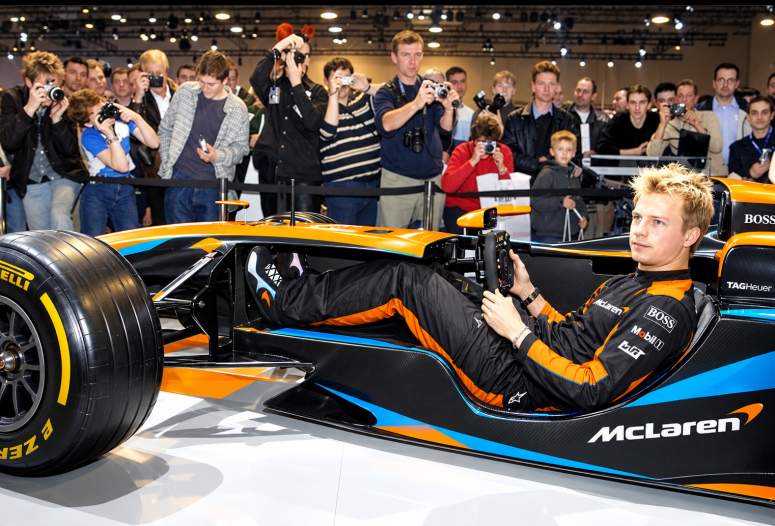
Formula One is often misunderstood as a sport that asks little of its drivers physically. The car, the argument goes, does all the work. That perception could not be further from the truth. Behind every race lies a training regime that rivals those of the most demanding sports in the world, and a physical toll that few spectators ever see.
The Weight of Speed
The central challenge is gravitational force, measured in g. Through fast corners, a modern Formula One car can subject its driver to sideways loads of five g or more, and heavy braking produces similar forces that throw the driver forward into the belts. At five g, a driver’s head and helmet, which together weigh around six or seven kilograms at rest, effectively weigh more than 30 kilograms. The neck must hold that weight steady through corner after corner, lap after lap, for up to two hours.
Fighter pilots experience higher peak forces, up to nine g, but they do so in short bursts and wear special suits that help keep blood flowing to the brain. Formula One drivers have no such suit, and they face heavy loads again and again, often sideways, several times on every lap. It is this repetition, rather than any single peak, that makes the demand so unusual.
“It is the repetition, not any single peak, that makes the demand so unusual.”
To cope, drivers train muscles most people never think about. Neck work uses weighted harnesses, resistance bands, and specialised machines that pull the head in every direction. Core strength keeps the body stable in the seat, while the arms and shoulders must turn the wheel against heavy steering loads. Braking calls for extraordinary force as well, since the pedal can demand more than 100 kilograms of pressure from the left foot, many times per lap.
Endurance matters just as much as strength. A driver’s heart rate commonly sits between 160 and 180 beats per minute for most of a race, levels comparable to those of endurance athletes in competition, so training includes long sessions of running, cycling, and swimming. Many drivers work all year with a dedicated performance coach who travels with them to every race and manages their training, recovery, nutrition, and sleep.
Racing in the Heat
The physical toll is at its harshest in hot, humid races. In Singapore, where the air is thick and cockpit temperatures can climb above 50 degrees Celsius, drivers commonly lose around three kilograms of body weight through sweat in a single Grand Prix. They must drink carefully before and during the race, but a driver can carry only a limited amount of fluid, and it often turns warm within a few laps.
The 2023 Qatar Grand Prix showed how close the limit can be. Heat and humidity were so severe that one driver retired from the race feeling unwell and another was sick inside his helmet while driving. Others spoke afterwards of feeling close to losing consciousness. The FIA responded by studying the problem in detail, and from 2025 it introduced a heat hazard rule under which drivers can wear cooling vests when extreme temperatures are forecast.
The Mind at 300 Kilometres per Hour
Formula One is as much a mental contest as a physical one. At 300 kilometres per hour, a car covers the length of a football pitch in little more than a second. A driver must judge braking points to within a few metres, read the behaviour of tyres that change with every lap, and make decisions in a fraction of a second while wheel to wheel with a rival. One lapse in concentration can mean a crash, a lost position, or a lost championship.
“At 300 kilometres per hour, a car covers the length of a football pitch in little more than a second.”
The workload does not stop at steering and braking. The steering wheel of a modern car carries dozens of buttons, switches, and dials that control how the car deploys its energy, how its differential behaves, and much more. Drivers adjust these settings many times per lap while listening to their race engineer on the radio, tracking the gaps to their rivals, and planning the next overtake. The 2026 cars, which rely far more heavily on electrical power, have made energy management an even larger part of the task.
Teams therefore treat the mind as seriously as the body. Drivers use cognitive training tools to sharpen reaction time and focus, and many work with sports psychologists to handle pressure, criticism, and the swings of a long season. Sleep and recovery receive careful attention, since a calendar that crosses many time zones would otherwise leave drivers tired at the moment they most need to be sharp. The best drivers share a quality that is hard to measure: the ability to stay calm when everything around them is chaotic.
The Team Behind the Visor
While the drivers command most of the spotlight, they are only the visible tip of a very large organisation. A leading Formula One team employs many hundreds of people, and the largest employ more than a thousand. Designers, aerodynamicists, and engineers shape every component of the car, factory staff build and test it, and strategists decide when to stop for new tyres and which compounds to use. At the track, a race engineer speaks to the driver throughout the weekend, turning data from hundreds of sensors into clear instructions.
Since 2021, a cost cap has limited how much each team may spend on the performance of its cars in a season. The aim is to narrow the gap between the richest teams and the rest, and it forces everyone to work efficiently. Success now depends less on the size of a budget and more on how wisely it is spent.
“The driver is only the visible tip of an organisation that can number more than a thousand people.”
Two Seconds in the Pit Lane
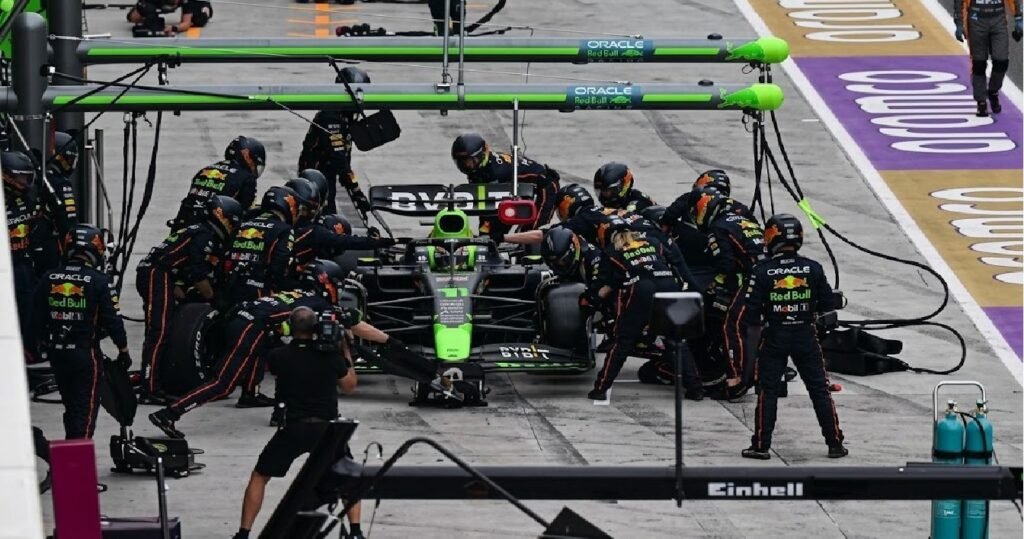
Nowhere is teamwork more visible than in the pit stop. Around twenty mechanics surround the car the moment it stops. In roughly two seconds they lift it, remove and replace all four wheels, and send it on its way. At the 2023 Qatar Grand Prix, McLaren completed a stop in 1.80 seconds, a record at the time. Each crew member has a single role, rehearsed hundreds of times in practice, and a stuck wheel nut or a missed signal can cost a race. Between sessions, the same mechanics can rebuild a badly damaged car in a matter of hours, often working late into the night to have it ready for the next day.
A Travelling City
Behind the pit wall lies one of the most demanding logistical operations in world sport. For each race, teams transport complete garages, spare parts, tools, computers, and hospitality units, along with the cars themselves. Urgent items travel by air on chartered cargo aircraft, while bulkier equipment is shipped by sea weeks or months in advance, with several identical sets sent around the world in rotation. In Europe, fleets of trucks carry the paddock from one circuit to the next, often with only a few days between races.
The calendar makes this harder every year. A record 24 races were planned for 2026, stretched across five continents from March to December. Moving the sport safely and on time, while pursuing a target of net zero carbon emissions by 2030, is a challenge that rarely makes headlines but never goes away.
Two Championships, Two Loyalties

What makes Formula One even more fascinating is that two separate battles unfold at the same time: the Constructors’ Championship and the Drivers’ Championship. Points go to the top ten finishers in each Grand Prix, from 25 for a win down to one for tenth place, with extra points available at shorter sprint races on selected weekends. Every point therefore counts twice, once for the driver and once for the team.
The Team Prize
The Constructors’ Championship rewards the team whose two drivers together score the most points across the season. It reflects the collective effort of the whole organisation, from the designer’s drawing board to the pit crew’s wheel guns, and it carries real financial weight. The sport distributes its prize money largely according to where each team finishes in this table, so a single place can be worth many millions of dollars.
Finishing first does not bring an easy path the following year, however. To promote closer racing, the rules give the most successful teams the least time for aerodynamic testing in wind tunnels and computer simulations, while teams lower down the order receive more. The champions gain prestige and the largest share of the prize money, but they must then defend their position with fewer resources for development. It is one of the ways the sport tries to stop any single team from dominating for too long.
Because the team title matters so much, drivers are sometimes asked to set their own ambitions aside. A team may instruct one driver to let the other pass, or to hold position rather than attack. Such team orders have produced some of the most debated moments in the sport’s history. At the 2013 Malaysian Grand Prix, Sebastian Vettel ignored an instruction to stay behind his Red Bull teammate Mark Webber and passed him to win, causing a bitter rift within the team. At the 2024 Hungarian Grand Prix, McLaren asked Lando Norris to hand the lead back to Oscar Piastri, and after several tense laps of radio exchanges, he did.
The Individual Crown
The Drivers’ Championship is far more personal, and often far more ruthless. Here every driver fights for individual glory, and the first rival each must beat is the teammate in the identical car, the only true benchmark of ability on the grid. Across a season of more than twenty races, the points add up to crown one driver as Formula One World Champion, the title every child in a kart dreams of winning.
The margins can be astonishingly small. Kimi Räikkönen won the 2007 title by a single point, and Hamilton won in 2008 by the same margin. In 2021, Hamilton and Verstappen arrived at the final race in Abu Dhabi level on points, and the championship was decided on the last lap. In 2025, Norris claimed his first title by two points over Verstappen at the season finale. After months of racing and thousands of kilometres, the difference between champion and runner-up can come down to a single overtake.
“After months of racing and thousands of kilometres, the difference between champion and runner-up can come down to a single overtake.”
A New Era on the Grid
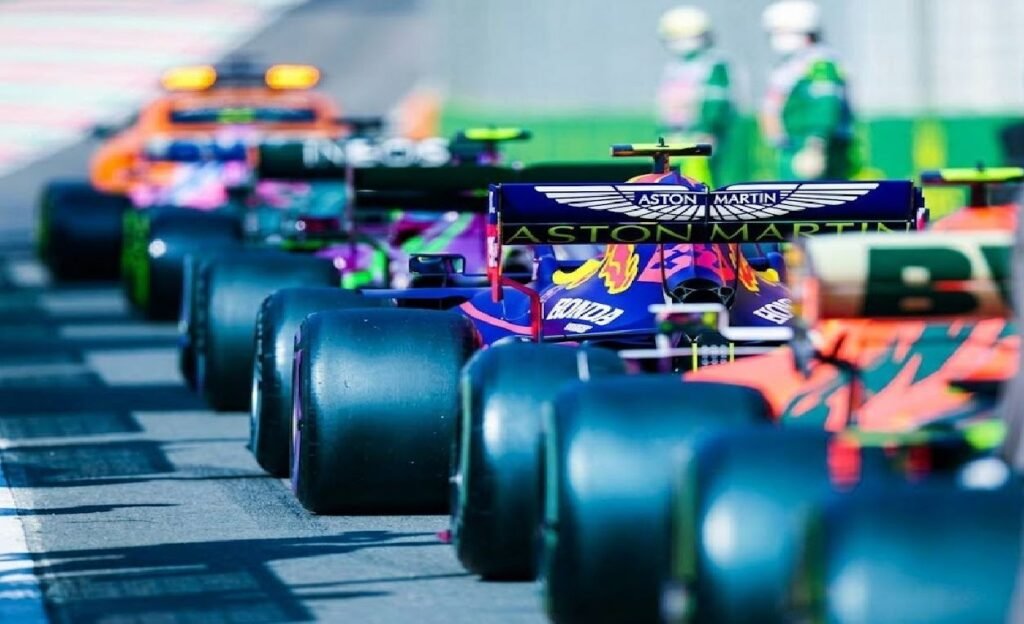
The 2026 season brought the largest change to the rules in a generation. The cars are smaller and lighter than their predecessors, and their power units now draw roughly half of their output from electrical energy, a sharp rise from earlier years. They also run on fully sustainable fuels, part of the sport’s effort to stay relevant to the future of road cars and to meet its own environmental targets.
The aerodynamics changed too. Movable wings at the front and rear now switch between a setting that gives more grip in the corners and one that cuts drag on the straights, replacing the drag reduction system that drivers had used to overtake since 2011. A new electrical boost, available to a driver running close behind a rival, has taken over part of that role. For drivers, the result is a car that demands fresh skills, from managing battery energy across a lap to adapting to a very different feel through fast corners.
The grid itself grew. Cadillac arrived as the eleventh team, the first new entry since 2016, and Audi took over the former Sauber operation as a full manufacturer team. Ford returned as a partner to Red Bull, and Honda began a new partnership with Aston Martin. For a sport once mocked as a closed club, the arrival of so many major car makers is a clear sign of its commercial strength.
“For a sport once mocked as a closed club, the arrival of so many major car makers is a clear sign of its strength.”
That strength comes from a far wider audience. Since Liberty Media bought the sport in 2017, Formula One has changed the way it tells its story. The Netflix series Drive to Survive, first released in 2019, introduced millions of new fans to the personalities behind the helmets, and a major Hollywood film followed in 2025. The sport now attracts a younger audience and a growing share of women, and F1 Academy, a series for young female drivers launched in 2023, aims to open the path to the grid for a group long shut out of it.
Beyond the Chequered Flag

Strip away the celebrity, and the glamour, and Formula One reveals itself as something far richer. It is a test of the human body under forces it was never built to bear. It is a test of the mind, which must make hundreds of precise decisions at speeds most people will never experience. It is a test of teamwork, in which a thousand people must perform flawlessly so that one car can gain a tenth of a second. And it is a test of character, in which drivers such as Lewis Hamilton show that talent, work, and courage can carry a person from a modest home to the top of the world.
The next time the lights go out and 22 cars surge towards the first corner, the spectacle will look as glamorous as ever. Behind every one of those cars, however, lies a childhood spent in karts, a body trained to its limits, and a team that worked through the night. That is what makes Formula One more than just racing.
ARTICLE CONTRIBUTOR:
HAREEM ASIM
The concept, structure and research for this article has been done by Miss Hareem Asim. She is an 18 years’ old, A-levels student based out of Lahore (Pakistan). Hareem is a huge Formula 1 enthusiast and, for a while, ran an Instagram page on F1 which surpassed a million views.
Hareem is interested in public speaking. She really enjoys baking, which is something she hopes to eventually pursue as a business someday.
Leave a Reply