
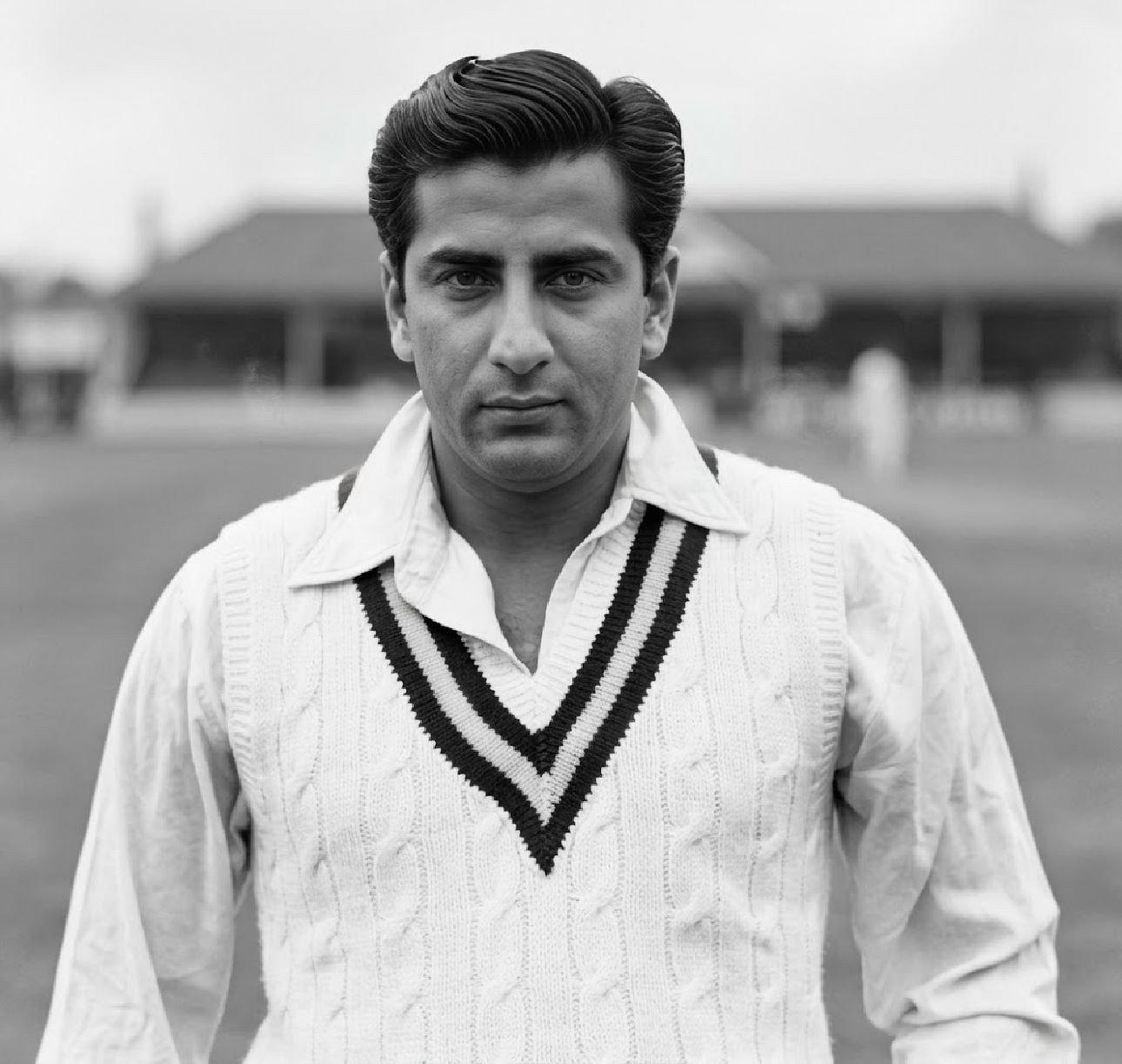
In the 1950s, a tall young man from Lahore gave Pakistan its first Test victories against India, England, Australia, and the West Indies. Seven decades later, his record still reads like the founding charter of the country’s cricket.
A Choice Made at Partition
Fazal Mahmood was born in Lahore on 18 February 1927 and began his first-class career at seventeen, bowling for Northern India in the Ranji Trophy. By 1947 his form had earned him a place in the Indian training camp at Poona, which was preparing for the tour of Australia that winter. Then came Partition. Travelling home to Lahore, he saw the violence that followed the division of the subcontinent, and when the Indian board later called him, he declined. He chose Pakistan, a country that did not yet play Test cricket and would not do so for another five years. It was a decision that cost him his youth at the highest level and gave his new nation its first great bowler.
Lucknow, 1952: The First Victory
Pakistan played its first Test at Delhi in October 1952 and lost by an innings. The side moved on to Lucknow, where the match was played on a jute matting pitch, a surface Fazal knew well from home. He took 5 for 52 in the first innings and 7 for 42 in the second, and India fell for 106 and 182. Pakistan won by an innings and 43 runs in only its second Test. Few new Test nations have won so soon, and none has owed a first win so plainly to one man.
The Oval, 1954: A Match That Named a Hero
Two years later Pakistan made its first tour of England. The four-Test series was badly hit by rain, and the visitors went into the final Test at The Oval one match down. On a pitch that favoured bowlers, the scores stayed low. Set 168 to win, England reached 109 for 2 and then lost eight wickets for 34 runs. Fazal took 6 for 53 and 6 for 46, and Pakistan won by 24 runs to level the series. No side had won a Test on its first tour of England before; India, by comparison, had waited twenty years to beat England at all. Fazal finished the series with 20 wickets, the English press made puns of his name, and in 1955 he became the first Pakistani chosen as one of Wisden’s Five Cricketers of the Year. In Pakistan he was, from then on, the hero of The Oval.
Karachi, 1956: The Craft Behind the Figures
His finest match came in October 1956, when Ian Johnson’s Australians stopped in Karachi on their way home from England. On the matting, Australia were bowled out for 80, and Fazal returned 6 for 34 and 7 for 80. His match figures of 13 for 114 remain the best of his career, and Pakistan won by nine wickets to record its first victory over Australia.
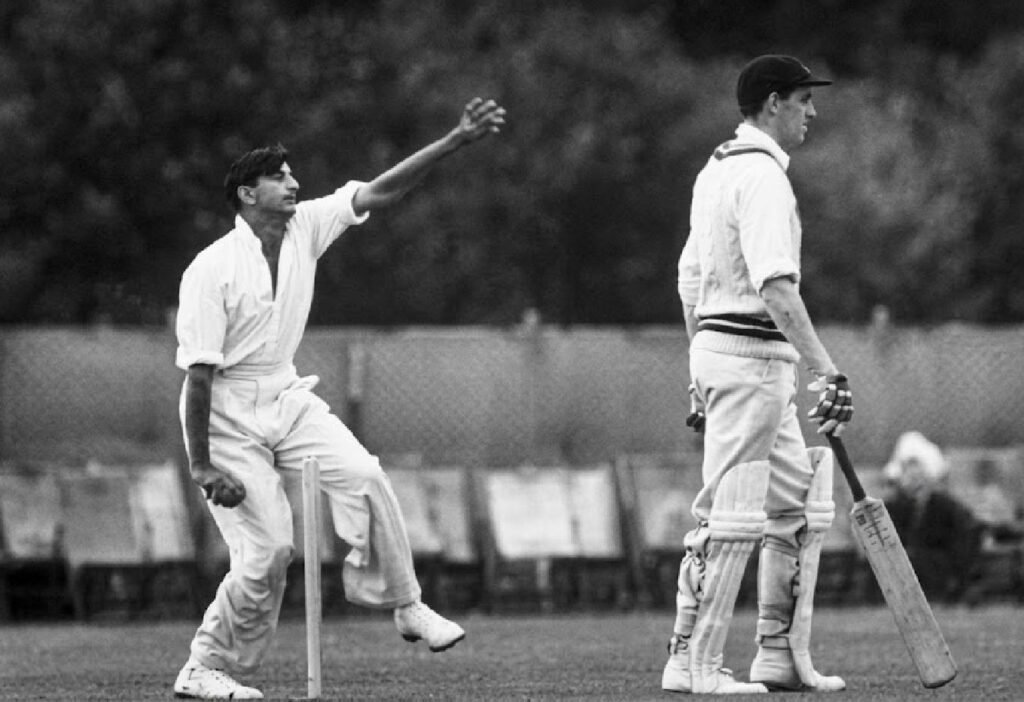
The numbers rest on a clear method. Fazal bowled at a brisk medium pace, moved the ball both ways off the seam, and made the leg cutter his signature delivery, a skill often credited to guidance from the Australian coach Frank Tarrant in Lahore. He was tall, accurate, and tireless. English observers compared him with Alec Bedser, the master of the same craft, and the Australian batsman Neil Harvey said that on matting Fazal “could make the ball talk.” He was hard to play anywhere and close to unplayable on the mat.
Workhorse and Captain
Talent of this kind was also a burden, because Pakistan had few other bowlers of his class. In the West Indies in 1957 and 1958 he bowled 250 overs in the first three Tests, yet he still took 20 wickets in the series, including eight in the final Test at Port of Spain, which Pakistan won. He was made captain for the home series against the West Indies the following season. He took 21 wickets in three Tests, became the first Pakistani to reach 100 Test wickets, in only his 22nd match, and took 12 for 100 at Dacca as Pakistan won the series 2 to 1.
As captain he led Pakistan in ten Tests, winning two, losing two, and drawing six. His leadership years were steady rather than bold, and the five drawn Tests in India in 1960 and 1961 reflected a cautious age of cricket on both sides. His last act came in 1962, when an injury crisis on the tour of England led the selectors to send for him at the age of 35. He ended his career with 139 wickets in 34 Tests at 24.70, a record he built in an era of long gaps between series and few matches.
Beyond the Boundary
Fazal was more than a bowler. He served as a police officer, and he was, by the standards of his day, a national celebrity: handsome, well groomed, and famous enough to appear in advertisements. After he retired, he stayed close to the game as an elder whose advice the Pakistan Cricket Board valued, and late in life he served as bowling adviser to a commission on illegal bowling actions. He set down his story in a memoir, From Dusk to Dawn. He died of a heart attack at his home in Lahore on 30 May 2005, aged 78.
The Measure of a Pioneer
Honours came during his life and after it. He received the President’s Pride of Performance award in 1958, the Hilal-i-Imtiaz was conferred on him posthumously in 2012, and in 2021 he was voted into the PCB Hall of Fame. Yet his true legacy is a line of descent. Pakistan has since produced a long line of fast bowlers who won matches the world remembers, and each of them followed a path Fazal cleared. Shoaib Akhtar called him the torch-bearer, and the title fits. Fazal Mahmood gave a new country proof that it could beat the best, and he gave it that proof in its first decade, when proof was what it needed most.
| FAZAL MAHMOOD AT A GLANCE | |
| Born | 18 February 1927, Lahore |
| Died | 30 May 2005, Lahore, aged 78 |
| Test career | 34 Tests, 1952 to 1962 |
| Test wickets | 139 at an average of 24.70 |
| Best match figures | 13 for 114 against Australia, Karachi, 1956 |
| Five wickets in an innings | 13 times |
| Ten wickets in a match | 4 times |
| Captaincy | 10 Tests: 2 won, 2 lost, 6 drawn |
| Major honours | Wisden Cricketer of the Year (1955); Pride of Performance (1958); Hilal-i-Imtiaz (2012); PCB Hall of Fame (2021) |
Leave a Reply