
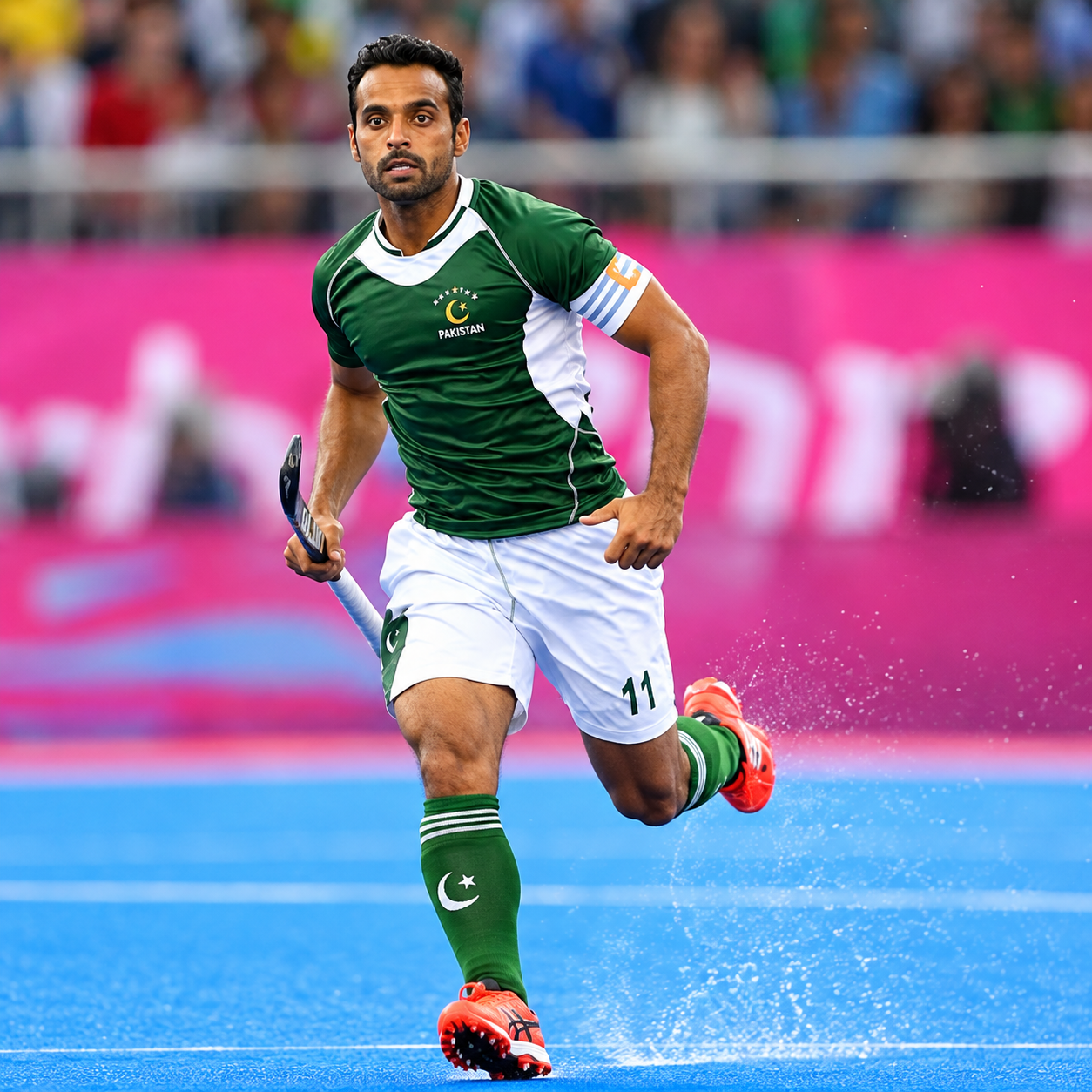
Sohail Abbas: The King of the Drag Flick
How a defender with a broken forward’s dream became international hockey’s most prolific goal scorer, and why Pakistan still calls him its own.
On 1 March 1998, at the Army Hockey Stadium in Rawalpindi, a young reserve rose from the Pakistan bench and struck a penalty corner past the Indian goalkeeper. The goal won the match. It also announced, though few in the stadium could have known it then, the arrival of the man who would become the most feared penalty corner specialist the sport had ever seen.
Sohail Abbas was born on 9 June 1977 in Karachi, at Holy Family Hospital in Soldier Bazaar. He grew up in a sporting household and attended Habib Public School, an institution long associated with the production of national hockey talent. As a boy he played as a forward, but his coaches moved him back to defense when his early performances did not convince them of his attacking instincts. The shift, unwelcome at the time, became the making of him. Determined to keep a hand in the scoring column despite his new position, Abbas turned to the drag flick and practiced it with a discipline that bordered on obsession, studying old match tapes and drilling long after his teammates had gone home.
The results came fast. In his first full year of international hockey, 1998, he scored twenty goals. The following year he scored sixty, a mark that broke the previous world record of fifty eight held by the Dutch great Paul Litjens. He became the fastest player in the modern game to reach one hundred international goals, doing so in two years, six months, and eighteen days, and he later became the fastest to reach two hundred. In 2002, at the World Cup in Kuala Lumpur, he finished as the tournament’s joint top scorer and, in the same year, passed Hassan Sardar to become Pakistan’s all time leading goal scorer.
The defining moment of his career arrived in October 2004, during the Champions Trophy in Amritsar, India. There, in front of a crowd that included many of his fiercest rivals, Abbas broke Paul Litjens’s record for the most international goals scored by any player in the sport’s modern era. He retired shortly afterward, at the age of twenty seven, wishing to leave the game at the height of his powers. Hockey did not let him go for long. He returned to the national team in 2006 and continued to add to his tally for another six seasons, ending his international career with 348 goals in 311 appearances and twenty one hat tricks, including one double hat trick against Sri Lanka in a 15 to 0 win at the 1999 Asia Cup. No player in the artificial turf era of field hockey has scored more.
Abbas gave Pakistan more than numbers. In 2010, at the Asian Games in Guangzhou, he was part of the team that beat Malaysia in the final to win Pakistan’s first major hockey title in sixteen years. Two years later, after nearly a decade and a half of service to the national side, he was named captain for the London Olympics, a fitting close to a long and storied career. Away from the field, he organized charity matches through his Dutch club, HC Rotterdam, to raise funds for victims of the 2005 Kashmir earthquake, drawing players from several countries to the cause.
Abbas has spoken more than once about the roots of his discipline. He has said that his father, Syed Iftikhar Hussain, a former first class cricketer, always told him to follow his own judgment rather than take shortcuts, and that this advice guided him through both hockey and life. He has also spoken warmly of his mother, calling her his greatest supporter and crediting her for much of what he achieved. When asked what mattered most to him beyond the record books, he offered a simple answer, that inner peace mattered more than money or fame. His faith runs through his reflections as well. He has attributed his international career, in large part, to what he calls the blessings of his faith.
Sohail Abbas did not merely play the position of penalty corner specialist. He rewrote what it could achieve, and in doing so gave Pakistan hockey one of its brightest chapters at a time when the sport needed heroes most.
Leave a Reply