
The History, Growth, and Future of the Winter Olympic Games
A Festival Born in the Shadow of Mont Blanc
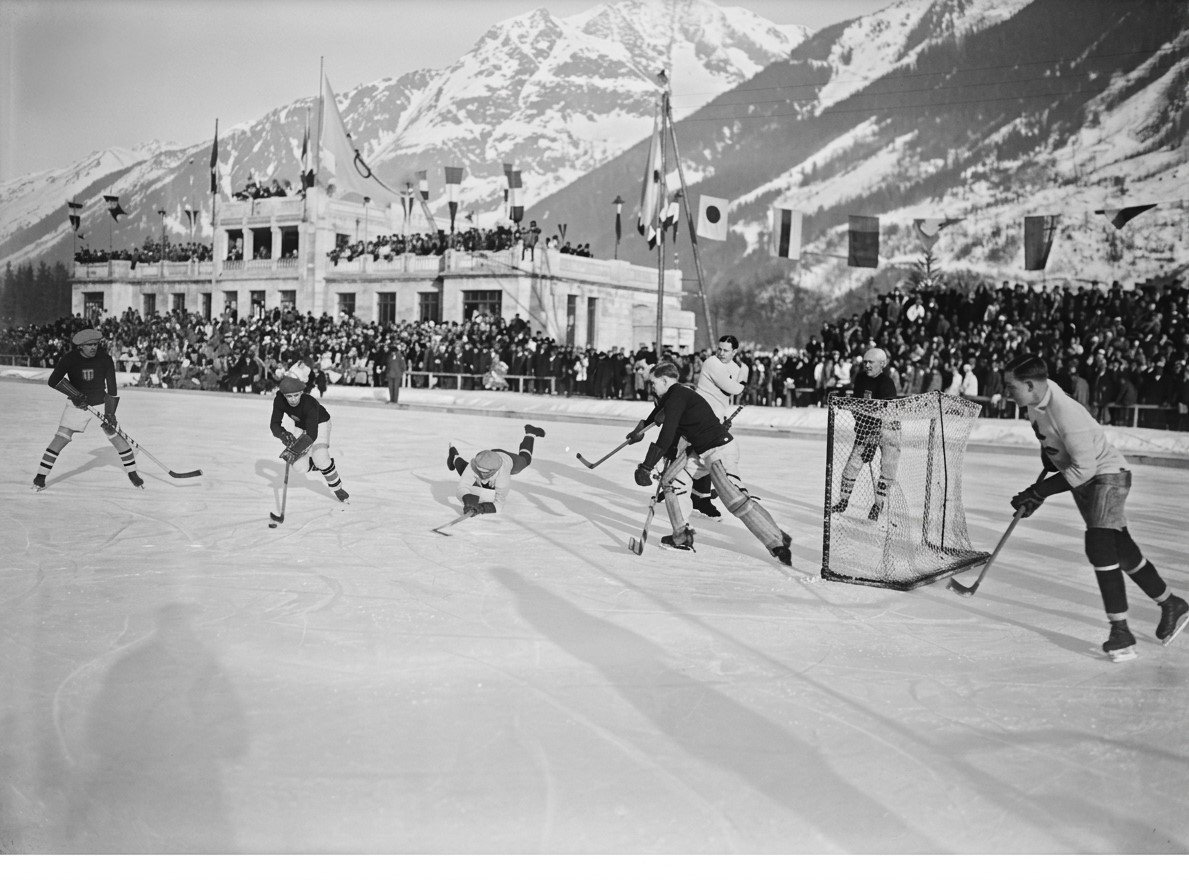
Every great institution begins as a modest gathering that nobody quite trusts yet. In January 1924, an assembly of skaters, skiers, and curlers arrived at the foot of Mont Blanc for what organisers cautiously named the International Winter Sports Week. The Scandinavian nations, proud owners of the long-running Nordic Games, worried that a rival winter festival under the Olympic banner would drain attention from their own tradition. Pierre de Coubertin, the founder of the modern Olympic movement, had his own reservations about diluting a summer festival built on classical ideals with events staged on ice and snow.
The doubts did not survive contact with the mountain. Over twelve days, 258 athletes from sixteen nations competed in sixteen events across six sports, watched by ten thousand paying spectators and two hundred journalists. Charles Jewtraw of the United States claimed the first gold medal in Winter Olympic history in the 500 metre speed skating, while Norway’s Thorleif Haug became the first athlete to win three individual gold medals at a single Winter Games. The Canadian ice hockey team, a group of amateurs from Toronto, outscored its opponents by a combined 110 goals to 3 across the tournament, an early sign of the dominance that would follow the sport for decades.
“Winter sports have about them a certain purity.” Pierre de Coubertin, 1924
The Chamonix gathering also settled a governance question that had trailed winter sport for years. Skiing federations across Europe had struggled to agree on shared rules for competition, and the International Ski Federation formed only months after the Chamonix events closed, a direct response to the need for a single body capable of sanctioning Olympic skiing worldwide. Speed skating, figure skating, ice hockey, and bobsleigh already had their own international federations in place, but skiing had lagged behind, and the success of the 1924 competition gave the sport the push it needed to organise itself along the same lines as its winter counterparts. Within a few Olympic cycles, every major winter sport had a governing federation capable of setting standards, sanctioning world championships, and feeding qualified athletes into the Olympic programme, a structure that remains largely intact a century later.
It was only in 1926, at an IOC session in Lisbon, that the Chamonix gathering received its true title: the first Olympic Winter Games. The retroactive naming mattered less than the appetite it revealed. Four years later, Lake Placid hosted the second edition and introduced the formal medal ceremony that remains a fixture of the Games today. By 1936, when Garmisch-Partenkirchen welcomed the Games to Bavaria, alpine skiing had joined the programme, radio brought the competition to listeners beyond the valley, and organisers lit a ceremonial flame for the first time at a Winter edition. A gathering that Scandinavian federations once feared as a threat had, within a dozen years, become an event that nations competed fiercely to host.
From a Winter Sports Week to a World Stage
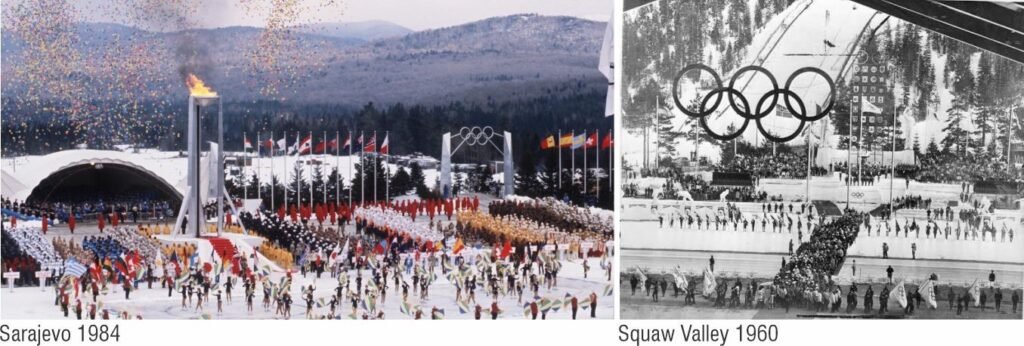
The decades that followed turned a regional curiosity into a fixture of the global sporting calendar. Squaw Valley 1960 brought the first live television coverage of a Winter Games to American audiences and introduced the athletes’ village as a permanent feature of Olympic planning. Sapporo 1972 carried the Games to Asia for the first time and saw officials swear the Olympic oath at a Winter edition for the first time. Sarajevo 1984 and Calgary 1988 expanded the roster of competing nations further still, while Albertville 1992 marked the final occasion on which the Winter and Summer Games shared a calendar year. From Lillehammer 1994 onward, the IOC staggered the two festivals by two years, a decision that gave winter sport its own uncontested moment in the global spotlight rather than a supporting role beside its summer counterpart.
The sporting programme grew in step with the calendar. Freestyle skiing arrived in the late 1980s and early 1990s, short track speed skating followed soon after, and snowboarding made its debut at Nagano 1998, a sport once dismissed by traditionalists as a passing fashion and now a reliable source of some of the Games’ most watched moments. Ski mountaineering, known to its practitioners as skimo, became the newest addition to the programme at Milano Cortina 2026, proof that the Winter Games remain willing to absorb disciplines born on the mountain rather than in a committee room. Each addition reflected a broader truth about the event: its organisers learned, gradually and sometimes reluctantly, that the surest way to keep the Games relevant was to let the sports people actually practised on snow and ice find a home within them.
Women’s participation expanded slowly but steadily across this same stretch of decades. Chamonix 1924 admitted women only to figure skating, and just thirteen of the 258 athletes on the ice and snow that year were women. Alpine skiing opened to women at Garmisch-Partenkirchen in 1936, cross-country events followed at Oslo 1952, and by the time Sarajevo hosted the Games in 1984, women competed across most disciplines on the programme. Ice dance joined the figure skating roster at Innsbruck 1976, women’s ice hockey debuted at Nagano 1998, and the introduction of the Winter Youth Olympic Games at Innsbruck 2012 gave younger athletes from smaller winter sport nations an early stage of their own before the senior Games. Milano Cortina 2026 fielded nearly as many women as men across its 2,884 athletes, a ratio that would have been unimaginable to the organisers who limited women to a single sport a century earlier.
Commercial and broadcast growth followed the same curve. What began as a festival covered by two hundred journalists in Chamonix now commands a media operation with tens of thousands of accredited personnel and a television and streaming audience measured in billions. The Winter Games built this reach not through spectacle alone but through the steady accumulation of stories: rivalries renewed every four years, records broken by athletes who spend a lifetime training for a single run down a mountain, and nations that use a fortnight of competition to announce themselves on a stage previously reserved for larger, warmer countries.
The Games in Numbers: A Century of Growth

Set the first Winter Games beside the most recent edition and the scale of the transformation becomes plain. Chamonix 1924 gathered 258 athletes representing sixteen National Olympic Committees, competing in sixteen events across six sports. Milano Cortina 2026, held one hundred and two years later across the Lombardy, Veneto, and Trentino-Alto Adige regions of Italy, welcomed 2,884 athletes, nearly evenly split between men and women, representing 92 National Olympic Committees in 116 events spanning eight sports and sixteen disciplines. The number of nations sending athletes grew nearly sixfold, the athlete population grew more than tenfold, and the event count grew more than sevenfold, all while the Games retained their essential structure of a fortnight built around ice, snow, and mountain terrain.
From sixteen nations on a single mountainside to ninety-two committees across three regions of Italy: the arithmetic of a century.
The audience for the Games expanded on a similar scale. Where two hundred journalists once filed reports from Chamonix by telegraph, Milano Cortina 2026 issued more than thirteen thousand media accreditations and reached an estimated 2.6 billion people worldwide across broadcast and digital platforms, according to figures released by the International Olympic Committee following the closing ceremony. Norway topped the medal table at Milano Cortina with eighteen gold and forty-one total medals, both national records for a single Winter Games, a reminder that even as the event has grown into a global spectacle, it remains, at its core, a contest decided by hundredths of a second and millimetres of snow.
Technology has done as much as television to change how the Games are watched and judged. Photo finish equipment settled speed skating margins invisible to the naked eye as early as the 1930s, and today’s timing systems measure to the thousandth of a second across sliding sports where the difference between gold and fourth place regularly comes down to a fraction of a heartbeat. Video review now supports officials in figure skating, ski jumping, and snowboard, reducing the scope for the kind of scoring controversy that once dogged the sport, while GPS tracking and biometric sensors give broadcasters and coaches alike a stream of data that would have seemed like science fiction to the officials counting goals by hand in 1924. None of this technology changed what decides a Winter Games medal. It only made the margins that decide it visible to everyone watching.
Scale has brought its own complications. Hosting a Winter Games now requires investment in venues for sports that exist nowhere near most candidate cities, from bobsleigh tracks to ski jump towers, alongside accommodation, transport, and security infrastructure built to a standard that few cities can justify for a single fortnight of competition every four years. The organisers of Milano Cortina 2026 answered that challenge by spreading venues across three regions and reusing sliding tracks and ski jumps built for earlier Italian Winter Games, a model the IOC has since pointed to as a template for future hosts rather than an exception.
New Ice, New Terrain: The Road to 2030 and Beyond
The Winter Games now face a test that no amount of broadcast revenue can solve on its own: a shrinking number of places on earth that can reliably guarantee snow and cold four years in advance. Climate scientists who study Winter Olympic host cities have warned for more than a decade that the pool of locations capable of hosting reliably is narrowing, a concern the IOC has openly acknowledged as it reshapes its bidding process around venue reuse and regional partnership rather than new construction.
The next two editions illustrate that shift plainly. The 2030 Winter Games will travel to the French Alps, spread across the Auvergne-Rhône-Alpes and Provence-Alpes-Côte d’Azur regions, with competition held in five Olympic villages and several venues inherited from the Albertville 1992 Games, including the sliding track at La Plagne and the ski jump at Courchevel. Four years later, in 2034, the Winter Games return to Salt Lake City, Utah, thirty-two years after the city’s first turn as host in 2002. Utah’s bid rested almost entirely on reusing existing facilities, a proposal that let organisers promise all thirteen competition venues from 2002 without new construction, a financial and environmental case that carried real weight with IOC voters weighing the cost of newer, untested bids.
The next Winter Games will be won as much by what a city already has as by what it promises to build.
The IOC has folded this shift in host selection into a broader sustainability commitment adopted under its Agenda 2020 and Agenda 2020 plus 5 reform packages, which push every future host, summer or winter, toward reusing existing venues, minimising new permanent construction, and demonstrating a credible plan for what a venue will do in the years between Games rather than the two or three weeks it hosts competition. Milano Cortina 2026 offered an early test of that policy at Winter Games scale, spreading events across three regions rather than concentrating them in a single city and returning to sliding tracks and ski jumps built for the Cortina 1956 and Turin 2006 Games rather than commissioning new ones. The IOC’s own review of the Games, published within months of the closing ceremony, held up that regional model as a template it intends to encourage in future bids rather than an improvisation forced by circumstance.
Beyond 2034, the picture grows less certain but no less interesting. Sweden and Switzerland, both passed over for 2030, remain active in conversations about future editions, and the IOC has signalled interest in eventually returning the Winter Games to Asia, with Sapporo and a Saudi Arabian bid built around the Trojena mountain resort mentioned as long term possibilities. Whatever city ultimately wins that bid will inherit a version of the Winter Games built less around fresh concrete and grand new stadiums and more around the question that now shapes every candidacy: can this place still guarantee the cold and snow the competition needs, and can it do so without leaving behind venues no community will use again once the flame moves on.
What the Mountains Still Hold
A century after Chamonix, the Winter Olympic Games remain an unlikely combination of intimacy and scale. The sports themselves have changed little in their essential demand: an athlete, a slope or a sheet of ice, and a margin for error measured in fractions of a second. What has changed is nearly everything around that demand, from the number of nations able to send a team, to the audience watching from outside the mountains entirely, to the environmental arithmetic that now governs where the Games can even take place.
The story that began with sixteen nervous nations gathering beneath Mont Blanc has become one of the largest recurring gatherings on earth, built on the same wager that persuaded a skeptical IOC in 1924: that people would watch, and care, and return every four years to see who could go fastest down a mountain or across a sheet of ice. Milano Cortina 2026 proved that wager still holds. The French Alps in 2030 and Salt Lake City in 2034 will test whether it can hold under a changing climate and a shrinking list of willing hosts. What has not changed, and shows no sign of changing, is the pull of the mountain itself, and the athletes willing to give a lifetime of training to a run that lasts under two minutes.
Leave a Reply