
When we watch great athletes perform, we marvel at their explosive speed, technical precision, and physical dominance. Yet every elite coach, psychologist, and champion will tell you the same thing: physical talent is the entry ticket — mental strength is what wins the game.
This article examines why mental strength is not merely a supplement to athletic excellence but its very foundation. Drawing on sports psychology, neuroscience, and the lived testimonies of the world’s greatest competitors, we explore what it means to be mentally strong, how it is built, and why its cultivation has become the defining frontier of modern sports performance.
“Champions are not made in gyms. Champions are made from something they have deep inside them — a desire, a dream, a vision.” — Muhammad Ali
I. Defining Mental Strength in Sport
1.1 Beyond Toughness: A Precise Definition
In sports psychology, mental strength is understood as a multi-dimensional construct encompassing an athlete’s capacity to consistently perform at or near their optimal level regardless of the conditions surrounding them.
Dr. Jim Loehr, one of the pioneering figures in performance psychology, defines mental toughness as “the ability to consistently perform toward the upper range of your talent and skill regardless of competitive circumstances.” This definition is striking precisely because it is performance-focused, not emotion-focused. Mental strength is not about feeling fearless — it is about performing well even when afraid.
Modern sport psychologists have expanded this framework to identify several core components that constitute mental strength in an athlete: sustained concentration and attentional control, emotional regulation under pressure, resilience and recovery from setbacks, self-belief and confidence that is internally generated, motivation that transcends external reward, and the capacity to compartmentalise and maintain clarity when circumstances deteriorate.
1.2 The Physical–Mental Continuum
A false dichotomy persists in popular sporting culture — that physical training and mental training are separate disciplines. Neuroscience tells a different story. The brain does not merely observe physical performance; it governs every aspect of it. Motor control, pain perception, fatigue thresholds, reaction time, and tactical decision-making are all neural processes. The body is an instrument the mind plays.
Research published in the Journal of Applied Sport Psychology demonstrated that athletes who engaged in structured mental skills training alongside physical preparation improved performance metrics by an average of 12 to 17 percent — a figure that would be considered extraordinary if achieved through any physical intervention alone. The conclusion is unambiguous: to train the body without training the mind is to leave performance gains on the table.
II. Pressure: The Crucible of Championship

2.1 What Pressure Actually Does to an Athlete
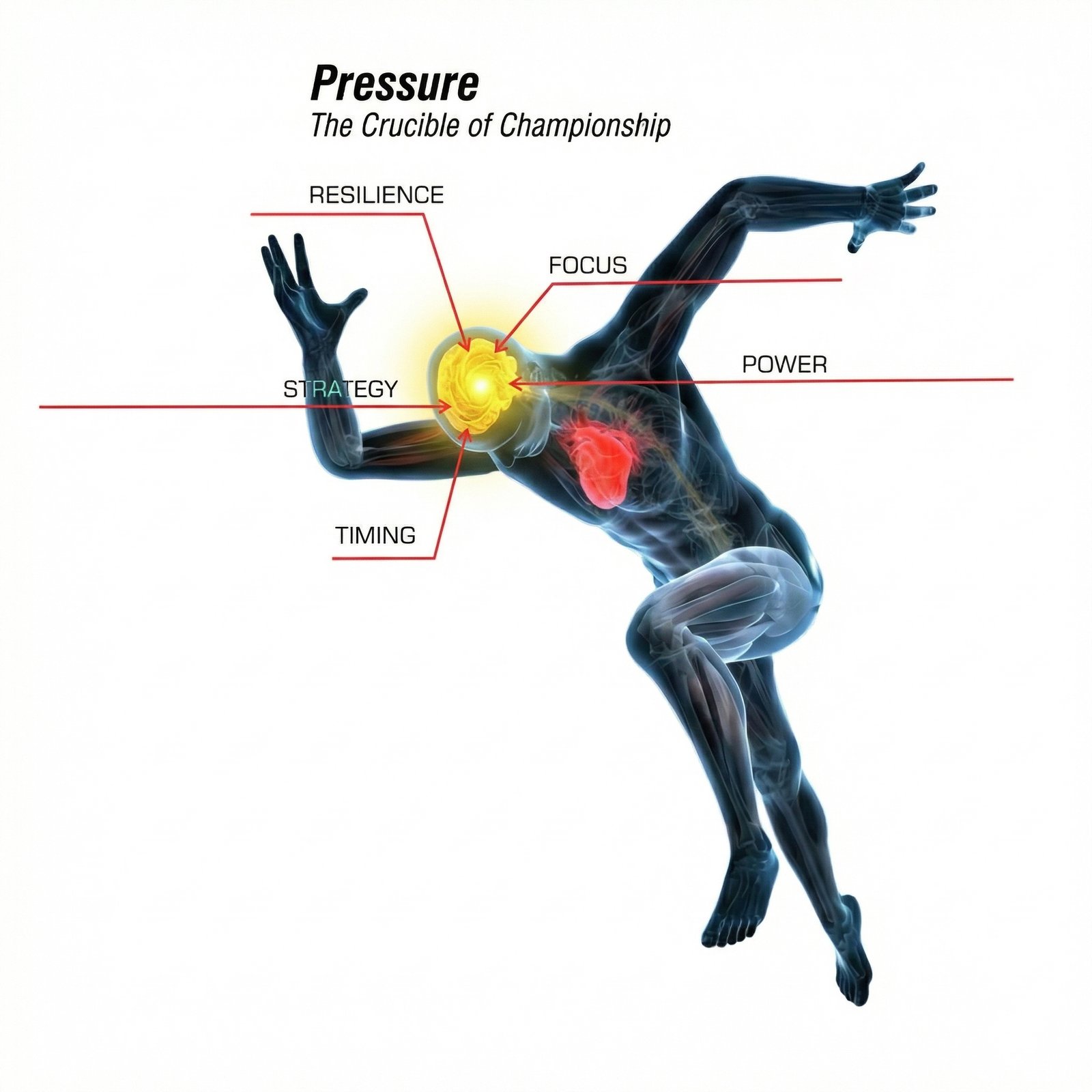
Pressure is the defining condition of competitive sport. It is not incidental to the experience of high-level athletics — it is the experience. And while all athletes feel it, only some flourish within it.
From a physiological standpoint, pressure triggers the stress response: cortisol and adrenaline flood the system, heart rate elevates, breathing shallows, and the body prepares for fight or flight. In moderate doses, this arousal state sharpens focus and accelerates reaction time. But past a critical threshold — unique to each athlete — the same response becomes disabling. Muscles tighten, decision-making narrows, and the body begins working against itself.
This phenomenon has a name in sports psychology: choking. And it is not, as commonly imagined, a character flaw. It is a neurological event. Research by psychologist Sian Beilock at the University of Chicago showed that under pressure, athletes begin to consciously monitor automatic skills — skills that were long ago encoded in procedural memory and are optimally executed without conscious thought. This over-thinking disrupts motor patterns and produces the errors we associate with a champion “falling apart” at the critical moment.
2.2 The Mentally Strong Athlete and Pressure
What separates the mentally strong athlete from their peers is not an absence of pressure — it is a fundamentally different relationship with it. Where a less mentally equipped competitor perceives a high-stakes moment as a threat, the mentally resilient athlete reframes it as a challenge. This is not semantics. Threat appraisal and challenge appraisal produce measurably different physiological and cognitive states, and the latter is demonstrably associated with superior performance outcomes.
Novak Djokovic, widely regarded as one of the most mentally formidable athletes in the history of sport, has spoken openly about his use of mindfulness and breathing techniques to maintain equanimity during pivotal match moments. “I practise my mental game as seriously as I practise my forehand,” he has said. “The physical tools are necessary, but the mental tools are what decide who wins.”
“It’s not the will to win that matters — everyone has that. It’s the will to prepare to win that matters.” — Bear Bryant
III. Resilience: The Architecture of Comeback
3.1 Adversity as an Inevitable Condition
Every athlete, without exception, will experience failure. Injuries will sideline careers. Slumps will erode confidence. Competitive defeats will come at the worst possible times. The question is not whether adversity will arrive — it is what the athlete does when it does.
Resilience — the capacity to absorb setbacks and return to performance — is one of the most studied attributes in sports psychology. It is also one of the most misunderstood. Resilience is not the absence of pain or distress. Resilient athletes feel the blow of failure as acutely as anyone. What differentiates them is their attributional style: how they explain adversity to themselves.
3.2 The Comeback Stories That Define Sport
History is filled with athletes whose greatest achievement was not a victory but a return. These are not merely stories of physical recovery. They are stories of mental reconstruction — of athletes rebuilding their identities, their confidence, and their sense of possibility after the foundations were shattered. Physical recovery without mental recovery is incomplete. The mind must believe in the comeback before the body can execute it
IV. Confidence, Self-Belief, and the Inner Narrative
4.1 Confidence Is Not Arrogance — It Is Architecture
Confidence is perhaps the most frequently discussed yet least scientifically precise concept in sport. In common usage it is treated as an emotion — something you either feel or you do not. In sports psychology, it is something more structural: a set of beliefs about one’s capacity to produce specific outcomes, built through specific experiences and cognitive habits.
4.2 The Inner Narrative: Self-Talk as Performance Tool
Research in cognitive-behavioural sport psychology has consistently identified self-talk as one of the most powerful determinants of athletic performance. The continuous stream of internal commentary that runs through an athlete’s mind during competition shapes their emotional state, their attentional focus, and ultimately the quality of their physical execution.
“You have to expect things of yourself before you can do them.” — Michael Jordan

V. Focus, Concentration, and the Art of Presence
5.1 Attention as a Finite Resource
Attention is the currency of performance. An athlete who can direct their focus precisely and sustain it for the duration that competition demands has an advantage that no amount of physical training can replicate. Yet attention is finite and susceptible to disruption. Crowd noise, a poor decision from an official, a provocative opponent, or simply the weight of the occasion — all compete for cognitive bandwidth.
5.2 Managing Distractions: Internal and External
Mental strength in the domain of focus involves two distinct capacities: the ability to block external distractions, and the ability to manage internal ones. External distractions — crowd behaviour, weather conditions, an opponent’s gamesmanship — require an athlete to develop what psychologists call a “performance cue” system: a set of specific, predetermined focal points that anchor attention to the task and away from the noise.
Internal distractions — anxiety, self-doubt, frustration, excitement — are more challenging and more consequential. The athlete who can acknowledge an emotion without being hijacked by it, who can note the surge of adrenaline before a critical penalty and use it as fuel rather than allowing it to become interference, demonstrates a form of emotional intelligence that is only developed through deliberate mental training.
VI. Building Mental Strength: Training the Mind
6.1 Sport Psychology and the Professionalisation of Mental Training
The integration of sport psychology into elite athletic programs has accelerated dramatically over the last two decades. The stigma that once surrounded discussions of mental health and psychological support in sport — the implication that seeking such help was a sign of weakness — has been replaced by a growing recognition that mental skills, like physical skills, are trained.

6.2 Mindfulness and Acceptance-Based Approaches
One of the most significant developments in applied sport psychology in recent years has been the adoption of mindfulness-based interventions. Rooted in contemplative traditions and operationalised for performance contexts, mindfulness training teaches athletes to observe their thoughts, emotions, and physical sensations without reactive judgement — to be fully present with their experience without being controlled by it.
6.3 Routines, Rituals, and the Architecture of Consistency
One of the most practical expressions of mental strength in competitive sport is the use of structured pre-performance routines. A pre-performance routine is a standardised sequence of physical, technical, and psychological actions performed before a performance or competitive action, designed to optimise arousal, sharpen focus, and activate the athlete’s optimal performance state. The evidence for pre-performance routines is unequivocal. The mechanism is partly cognitive — the routine narrows attention and activates appropriate performance cues — and partly neurological, as the repetition of familiar sequences activates well-rehearsed neural patterns associated with successful execution.
“Mental toughness is many things and rather difficult to explain. Its qualities are sacrifice and self-denial.” — Vince Lombardi
VII. The Mental Health Dimension

7.1 When Strength Requires Vulnerability
Any serious discussion of mental strength in sport must acknowledge its relationship to mental health. For too long, the sporting world projected a culture of invulnerability — the expectation that elite athletes should be impervious to psychological distress, that admitting struggle was incompatible with competitive excellence. The consequences of this culture were significant and, in many cases, deeply harmful.
True mental strength includes the capacity for honest self-assessment, the recognition of when professional psychological support is warranted, and the willingness to prioritise long-term wellbeing over short-term competitive pressure.
7.2 The Coach’s Role in Psychological Development
Mental strength does not develop in isolation. The role of the coach in shaping the psychological environment within which athletes train and compete is profound and frequently underestimated. Coaches who create psychologically safe training environments — where errors are treated as information, where process is valued alongside outcome, where athletes feel respected as individuals rather than instruments of performance — actively cultivate the conditions in which mental strength can develop.
VIII. Mental Strength Across the Sporting Landscape
8.1 Individual Sports: The Unfiltered Mind
In individual sports — tennis, golf, athletics, swimming, gymnastics — the athlete faces the competitive environment alone. There is no team to fall back on, no colleagues to absorb a defensive lapse, no shared burden of responsibility. The mental demands of individual sport are correspondingly acute. Every error is unambiguously the athlete’s own. Every moment of pressure is theirs to navigate without external support.
8.2 Team Sports: Collective Mental Strength
In team sports, mental strength acquires an additional dimension: the collective. A team whose individuals are mentally strong but whose collective culture is psychologically fragile will underperform relative to its talent. The dynamics of group confidence, shared identity, trust under pressure, and the ability to maintain cohesion through adversity are as important as any individual’s psychological profile.
IX. Conclusion: The Last Competitive Frontier
Sport stands at an extraordinary moment in its history. The physical limits of human performance are being approached. Training science, nutrition, biomechanics, and recovery technology have been refined to a degree that the marginal gains available through further physical optimisation are diminishing. The athletes who will define the next generation of sporting excellence will not merely be the fastest or the strongest. They will be the most mentally adept.
Mental strength — that compound of resilience, focus, self-belief, emotional regulation, and present-moment awareness — is not a mysterious gift bestowed upon a fortunate few. It is a capability, developed through deliberate practice, informed by science, shaped by experience, and deepened over the course of a career. Like every other aspect of athletic performance, it responds to training. And like every other aspect of athletic performance, its development begins with a decision: to take the inner game as seriously as the outer one.
The greatest athletes in history have always understood this, even when the language to articulate it was not yet available to them. Ali trained his mind in the gym before he trained his fists. Jordan practised self-belief in the dark moments no one saw before he delivered it on the stages everyone remembers.
The question for every athlete, coach, and sports organisation is no longer whether mental strength matters. That case is closed. The question is: what will you do about it?
#sport, #games, #athlete, #magazine, #youth, #action, #lifestyle, #speed, #energy, #talent, #Pakistan, #PakYouth, #PakSports, #wellness, #health, #wellbeing, #nutrition #life, #longevity, #enjoy, #joy, #passion, #positive, #pride, #mentalhealth, #strength, #focus
Leave a Reply